





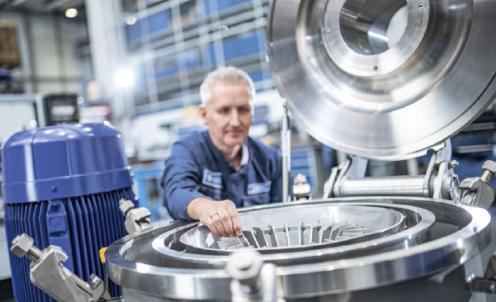
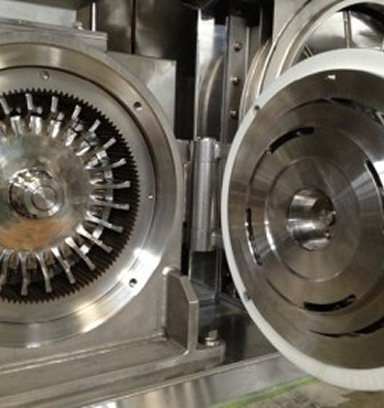
Linrex Mill LX
Materials such as rubber have elastic characteristics and are difficult to grind under normal conditions. However, by chilling them to below the brittle point, the material becomes brittle and can be ground by impact.
Principle of operation
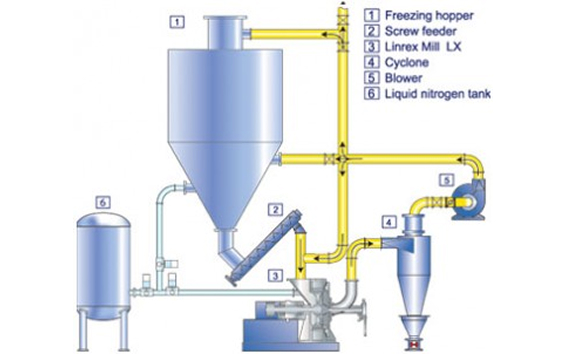
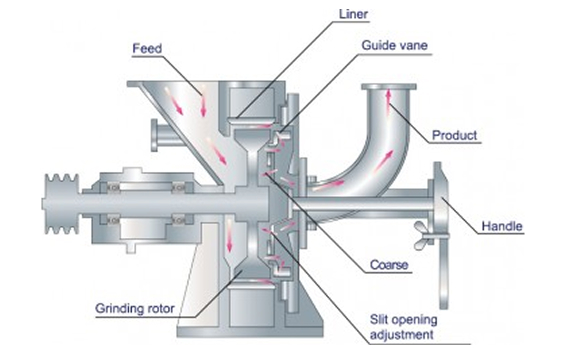
The feed material is first fed into the freezer to be chilled by Liquid Nitrogen (LN2). Once frozen, the material is then fed to the grinding chamber by a screw feeder. The grinding chamber itself is maintained at a low temperature by liquid nitrogen as well, allowing the materials to be ground and classified in a chilled environment. The ground materials are drawn in by the blower (installed within the grinder for the LX-0 model) into the cyclone, where the products are collected and discharged by the rotary valve (LX-0 model: Receiver tank only). Once the vaporized nitrogen gas flows through the cyclone and blower, it is recirculatedwithin the grinder and freezer for sensible heat recovery. Excess vapor is discharged from the unit.
Ideal grinding temperature, Glass transition point
The most important aspect of grinding at extremely low temperatures is minimizing the consumption of liquid nitrogen (LN2) and lowering the running cost by finding the ideal grinding temperature that allows for efficient grinding. Plastic materials have a glass transition point where the material becomes vitrified below a certain temperature. While grinding a vitrified material is much easier, our past data indicateds that the glass transition point is not necessarily the ideal grinding temperature.
Generally, the glass transition point range is extremely wide. The only way to find the ideal grinding temperature is through extensive testing and collecting large amounts of data. This means that if the temperature changes, it is equivalent to grinding a completely different raw material. Even if materials share the same name, it is thought that each specific molecular structure affects the ideal temperature. For example, polyethylene has an ideal grinding temperature of roughly -120°C, whereas polypropylene has an ideal grinding temperature of -100°C. The Linrex Mill can be cooled to a minimum temperature of approximately -180°C.
Liquid nitrogen (LN2) consumption amount
Most of the liquid nitrogen (LN2) consumption takes place at the grinder and blower to minimize heat generation. Therefore, excluding the raw material chilling procedure, once the cooling temperature is set, the LN2 consumption rate per unit of time becomes roughly constant. In other words, the LN2 consumption per unit of material is inversely proportional to the production capacity (throughput per unit of time). Hence, in order to minimize LN2 consumption, it is essential to prevent overgrinding of the products.
Features
Materials that are difficult to grind at normal temperatures can be easily ground.
Can produce particles with high flowability and angular shapes.
Degradation due to heat and oxidation, as well as flavor and aroma loss of foodstuffs and spices are prevented.
Can prevent odor, dust explosion, combustion, and noise associated with grinding.
Has an excellent cold insulation effect, with minimal loss of liquid nitrogen (LN2). (insulation box type)
Low power consumption for grinding.
Easy maintenance, inspection, and cleaning.
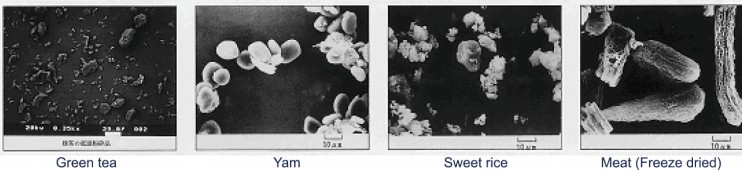
Grinding Material Reference
Application
Low melting-point materials
Suitable for grinding materials that soften/melt when ground at normal temperatures such as wax, plastics, etc.
Materials that degenerate under heat
Capable of grinding foodstuffs and spices (especially tea, pepper, cayenne pepper, etc.) without loss of flavor and aroma.
Wet/oily/fibrous material
Widely applicable for food materials. By grinding at low temperatures, fine particles with good texture can be produced without the loss of volatile components, flavor, and nutrition from heat.
Dust explosion, Combustible materials
The grinding process takes place in an inert gas (nitrogen) atmosphere (oxygen-free), limiting chemical reactions and oxidation, while preventing dust explosions and ignition.
Specifications
| Specifications | LX-0 | LX-1 | LX-2 | LX-3 |
|---|---|---|---|---|
| Motor - Mill(kW) | 2.2 (~3.7) | 7.5 (~11) | 15 (~22) | 37 |
| Motor - Blower(kW) | (built-in) | 2.2 | 7.5 | 11 |
| Motor - Feeder(kW) | (Manual feeding) | 0.4 | 0.75 | 1.5 |
| Dimensions - L (mm) | 1200 | 1500 | 1900 | 1800 |
| Dimensions - W (mm) | 1400 | 2400 | 3200 | 5200 |
| Dimensions | 1600 | 2800 | 3600 | 3900 |

Contact Us
Feel free to contact us for any inquiries.