







LIB Cathode
In Lithium Ion Batteries, recharge and discharge occurs through the movement of lithium ions between the cathode and anode. The material that takes in and discharges the lithium ion is called active material. Methods for producing these cathode active materials will be described in this passage. The production process is split into two separate procedures. The first is the chemical bonding process between active materials taken from materials called precursors; the second process is to adjust the synthesized active materials and coat onto the electrode current collector.
To start off, the technology behind precursors for cobalt based and manganese based cathode materials will be explained. While the leading cobalt based material is lithium cobalt oxide LiCoO2 LCO, there are other cobalt based materials called a ternary system such as Li (NiaMnbCo1-a-b) NMC and Li (NiaCobAl1-a-b) O2 NCA, as well as a quaternary system which is an active material made up of a complicated chemical composition. These materials are used in their respective fields to best utilize their features. For manganese-based materials, such materials as LiMn2O4 and Li2MnO3 can be named.
Cobalt based precursors include cobalt oxide, cobalt hydroxide, oxy cobalt hydroxide, cobalt carbonate, as well as lithium carbonate, lithium hydroxide, and manganese oxide. Manganese based precursors include manganese oxides and lithium carbonates. Active materials are often produced by the solid phase method.
The following passage will be an introduction to dry grinding, precision mixing, and drying technology used in the precursor production process before the furnace stage for synthesis reaction.
The solid phase method consists of mixing numerous solid raw materials together and a calcinations process. To perform the solid phase procedure efficiently, minimizing the amount of unreacted materials and controlling the calcinations temperature is essential. This is done through fine grinding and precision mixing of the raw materials, making powder-processing technology an important aspect of the production process.
Fine particle production of raw materials
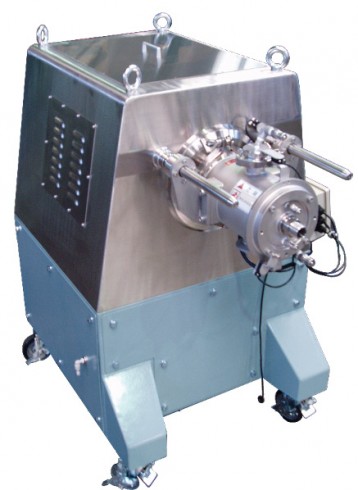
Mixing solid state materials are performed by using raw material particulates. The larger the individual particle sizes are - the longer time it takes for the calcinations process. Also for a reaction to occur, more than two different materials need to come in contact with each other. The larger the particle size, the possibility of unreacted materials appearing in the product becomes larger. Since each raw material has a different specific density, it is prone to becoming non-uniform. Larger particles have a greater tendency of this problem, with the reactivity declining as well due to the reduction in contact area between the particles. To solve this problem, fine particle production of the raw material is needed with an emphasis put on minimizing the amount of metal contamination. This process can be performed with classifier integrated ACM pulverizer, fluidized bed jet mill AFG, and spiral jet mill. In recent trends, a classifier integrated target type jet mill is also utilized for producing finer and sharper particle distributions.
Precision mixing for solid-state reaction
To accelerate the synthesis reaction through calcinations, separate precursor materials need to contact each other. However, from the fine particle production described in 2-1, the material’s adhesiveness and cohesiveness have increased making it difficult for different precursor materials to come in contact. To solve this problem, a mixer that can provide enough energy to the aggregates through impact and shearing force is essential. For this process, Hosokawa can offer the Cyclomix and Nobilta for this process which utilizes the impact and shearing strength, as well as compressed shearing force respectively.
Drying process
Some cobalt-based materials are synthesized using a wet process and is then calcined to produce precursors. Before the calcinations process, there is a need to separate and clean the powder and solvent. Since the slurry form of the raw material has a high viscosity and its dry form has a highly adhesive and cohesive characteristic, continuous operation using a standard flash dryer is extremely difficult due to blockages developing relatively easily. Another important aspect is to prevent reformation of aggregates, such units as the media mixer type dryer Xerbis, which has zero metal contamination, and mixing type, vacuum dryer can be utilized.
Cobalt Based
The following is an introduction of the production process of lithium cobalt oxide LiCoO2 LCO, which is one of the leading cathode precursors of lithium ion secondary batteries. The following process can be utilized for not only lithium cobalt oxides, but for a ternary system such as Li(NiaMnbCo1-a-b) NMC and Li(NiaCobAl1-a-b)O2 NCA as well as a quaternary system which is an active material made up of a complicated chemical composition. We will also introduce our technology which can be utilized in the production process after the calcinations process of precursor synthesis (cf. precursor material).
Disintegration
Synthesized cobalt based materials have a tendency to become larger in particle size due to the neck growth between particles. From this occurrence, the following problems arise. 1) Efficient turnover of the lithium ions from the interior of the particle becomes difficult. 2) The packing ratio decreases when coated onto the aluminum foil of the electrical current collector. 3) Increase in the unevenness of the coated surface. To relieve the following problems, the material needs to be ground to roughly 10-30μm. However, since the increase of fine particles has a negative effect on the flowability and slurry viscosity, it is essential to produce powders with the most suitable particle distributions. During the disintegration and grinding process, if contaminations (especially metal contaminations) enter the cathode active materials, it could lead to short circuiting, overheating of the battery from electrochemical reaction, and combustion. Therefore, it is essential to minimize the amount of contamination as much as possible.
To fulfill these needs, our grinding units can be manufactured using tungsten carbide as well as coating fine ceramic particles onto the surface of metals to minimize abrasions. We also have an ACM Pulverizer model called the ACM-HC with powder contact parts made of all ceramic material to promote a metal contamination free grinding process. It is an unit often used within the cathode production line. Hosokawa can offer metal contamination free systems for not only grinding units but for piping and bag filters as well. To increase the conductivity and flowability of the ground powders, processes of additive coating and compacting can be performed using the Nobilta.
Synthesizing nano-particles
For synthesizing active materials with nano-sized primary particles, wet processes including spray pyrolysis methods has been implemented. However, for dry processes, our Nanocreator which utilizes the flame atomization method is being used widely in research and development.
This unit synthesizes oxidized nano-particles by spraying raw material solutions into a flame and instantly combusting the materials for an oxidizing reaction. Once oxidized, the material is quickly cooled by gases. By mixing multiple solutions before spraying, a multi-composite chemical compound can be synthesized. Multi-component metal oxides can be effectively utilized for additives to cathode materials.
Surface Treatment
Multiple chemicals are coated onto the surface of the active materials to increase charge/discharge capacity, rate characteristics, cycle characteristics, safety, and reliability. For example, reducing the battery’s internal resistance through solidifying carbon black base materials to assist conductivity is a widely used method.
Recently, to increase rate characteristics and temperature stability, methods of applying a layer of ceramics to the active material as well as solidifying onto the surface of nano-particles are being used. These processes perform the sol-gel process, chemical reaction, and the absorption process during the liquid phase, then put through the calcinations process. It requires a drying process which increases energy cost and left-over solutions, having a negative effect on the quality. This passage will introduce the dry process technology of solidifying and coating nano-particles onto the surfaces of sub-micron to micron sized particles. For surface treatment of cathode materials, the dry process particle compounding unit Mechanofusion and Nobilta are often used. In recent trends, the ceramic type Nobilta is widely being utilized.
By coating materials such as Acetylene black particles onto LCO, Aluminum nano-particles onto NCA, Aluminum nano-particles onto NMC, and LiFePO4 onto LiMn1.5 Ni0.5O4, not only is the cycle characteristic and bulk density increased, but the amount of solutions required in the next process can be decreased as well.
Analysis of the Powder
Analysis of the powder’s characteristics is essential for the powder process and quality control. By installing an online particle distribution measuring unit with grinders or classifiers, real-time quality control of the product size can be performed. The Powder Tester is used worldwide as a standard unit for quantitative evaluation of the powder’s flowability and tap density, evaluations that would normally greatly differ if operated manually and/or analysis method. Therefore, the Powder Tester can be used for checking the quality of the purchased material, evaluation of the powder being produced for preventing problems that may arise during operation, and quality control of the final product. In addition, for analysis of wettability and wetting rate which are essential characteristics for determining the pasting process and reactivity of the electrolytic solutions, the Peneto Analyzer is utilized for characteristic analysis of active materials for batteries as well.
Feeding and product collection, filling and measuring, protection of the work environment
In addition to mills and mixers, material feeding devices such as the Finetron, bag filters used for separating and collecting fine particles from the air, Stott hygienic filling and weighing systems for weighing powders while filling, and chemical hazard preventive units such as the safety booth utilized for protecting workers and the environment from hazardous powders, as well as preventing cross contamination for quality control, are important peripheral equipment.
When it comes to structuring a battery material production process, it is important to not only put an emphasis on individual process equipments, but to look at the material balance as a whole, including the furnace and sieve equipment. Hosokawa has the strength in advising and offering such production processes
Phosphate Based
This passage will introduce the production flow of producing Iron Phosphate Lithium LiFePO4, one of the leading phosphate based cathode active materials for lithium ion secondary batteries. Recently, Olivine type cathode materials such as LiMPO4 (M: Mn, Mg, Ni) is rapidly being developed and implemented due to its cheap costs and the fact that it does not require any rare metals.
Phosphate based cathodes are synthesized by a calcination reaction under a solid phase method. Its production process is very similar to that of Cobalt based Cathodes. Therefore, the powder processing technologies being utilized are similar as well. However, most precursors for Phosphate iron Lithium are synthesized using a wet process method, additional new powder processing technologies are utilized to separate and clean the powders from the solutions used during the synthesis of precursors before the calcination process, as well as a drying process. The primary calcination process is used for increasing crystallization as well as synthesizing the unreacted materials, while the second calcinations process is required for carbon coating.
Drying Process
For synthesizing phosphate iron lithium, depending on the raw material and/or synthesis method, there is a possibility that the viscosity of the solutions will increase. From this occurrence, synthesis of precursors under a wet process sometimes end part way.
Also, for phosphate based materials, the diffusion speed of the lithium ion is slower compared to a cobalt based material, leading to a lower conductivity. Therefore, the primary particles after the calcination process need to be below sub-micron sizes. To fulfill this requirement, while considering the particle size growth during the calcination process, the aggregate formation needs to be prevented during the drying process and prior generation for fine particles are essential. The media mixing type dryer Xerbis which features a zero metal contamination characteristic is the most suitable machine for this process.
Below is the actual reference value of a drying and grinding system (XB-900) for precursor production. While the customer’s requirement was an average particle size of 4μm, we were able to produce products with average sizes of 3μm with the actual unit.

Contact Us
Feel free to contact us for any inquiries.