






Technical Ceramic
For production of technical ceramics, aluminum oxides, zirconium oxides, silicates and silicon carbides are key materials.
Technical ceramics are used in the applications for metalworking, electronics, automotive engineering, medical technology, optical technologies,and many more.
Aluminum oxide is and will become the most widely used ceramic high-performance material and is used as wear and corrosion protection in plant construction, as well.
The production of finest powders sets highest demand on machinery and equipment for fine grinding and classifying, in particular on wear protection, fineness, low contamination.
Process
With the rapid development of the high-end advanced ceramics industry, advanced ceramic materials with extreme requirements for contamination control, such as silicon carbide (SiC), have seen continuously deepening applications in high-end sectors including semiconductors, new energy, and aerospace. Accordingly, the requirements for the ultra-fine particle size, particle size uniformity, batch-to-batch purity, and morphological integrity of raw material powders are also constantly escalating.
The agglomeration and deagglomeration of ultra-fine powders is a common core pain point faced by the entire advanced ceramic raw material production and processing industry. Ultra-fine ceramic powders with a particle size below 1 μm have extremely high surface energy, and are highly prone to forming soft agglomerates or even hard agglomerates during preparation, post-processing, and transportation. Mainstream process routes in the industry need to dedicate deagglomeration process to bring the powder specifications in line with the requirements of subsequent ceramic sintering.
Currently, for the large-scale production of ultra-fine ceramic powders with a particle size below 1 μm, the traditional wet grinding process is the mainstream solution in the industry. Although this process can achieve ultra-fine comminution, it has many unavoidable inherent defects:
Cumbersome and lengthy process flow: It requires multiple pre- and post-treatment processes including raw material slurrying, wet grinding, solid-liquid separation, powder drying, and deagglomeration, resulting in a long production cycle, numerous process control links, and a high risk of batch stability fluctuations.
Persistently high energy consumption across the entire process: Wet grinding requires operation with dispersing media throughout the whole process, and the subsequent drying step is a major energy consumer. Coupled with the additional energy consumption of forced deagglomeration, the comprehensive energy consumption of the entire process remains stubbornly high, which significantly drives up the production and operation costs of enterprises.
Risk of additional contamination: Under the production model with multiple processes and a long flow path, foreign impurities are easily introduced into the material during repeated transfer, making the process unable to adapt to the production of advanced ceramics such as silicon carbide, which have extreme requirements for low contamination and high purity.
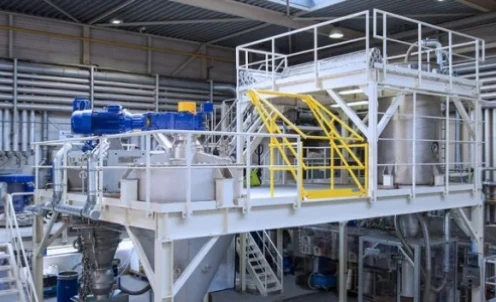
PULVIS Vertical Agitator Ball Mill: The Ideal Alternative to Wet Grinding
Targeting the common industry pain points of advanced ceramic powder processing and the inherent defects of existing processes such as traditional wet grinding, we have launched the PULVIS Vertical Agitator Ball Mill. Specifically engineered for the high-quality grinding needs of high-end ceramic materials, it is the perfect grinding system to meet the most stringent quality requirements for advanced ceramic materials. Its core advantages are as follows:
Dry process replacing wet process for a minimalist and highly efficient full flow: It enables direct dry production of ultra-fine ceramic powders with a particle size below 1 μm, eliminating the necessary supporting processes of the wet process including slurrying, solid-liquid separation, and drying. This significantly shortens the production cycle, reduces process control links, and remarkably improves batch stability.
Abrasion-free design for maximum assurance of powder purity: The equipment adopts an abrasion-free grinding structure, which is fully compatible with advanced ceramic materials such as silicon carbide (SiC) that have extreme requirements for contamination control. It eliminates the introduction of impurities during the grinding process at the source, ensuring consistent batch-to-batch purity of the powder.
Significant energy saving effect for greatly reduced operating costs: Compared with jet milling, the most energy-intensive comminution process, it delivers a comprehensive energy saving of up to 40%. Meanwhile, by eliminating high energy-consuming processes such as drying, its comprehensive energy consumption is far lower than that of the full traditional wet grinding process, fundamentally cutting down the production power costs of enterprises.
Superior particle size control for optimized powder performance: Compared with traditional wet grinding, it achieves a much steeper particle size distribution with a precisely defined top cut size, greatly improving powder uniformity and perfectly matching the stringent requirements for sintering performance and finished product quality of high-end advanced ceramics.
Compact design with strong full-scenario adaptability: The equipment features an integrated compact structure, and the full range of models is available with drive power up to 75 kW. It can flexibly meet production requirements of different capacities and fineness levels, and is suitable for ultra-fine grinding operations of various types of ceramic raw materials.
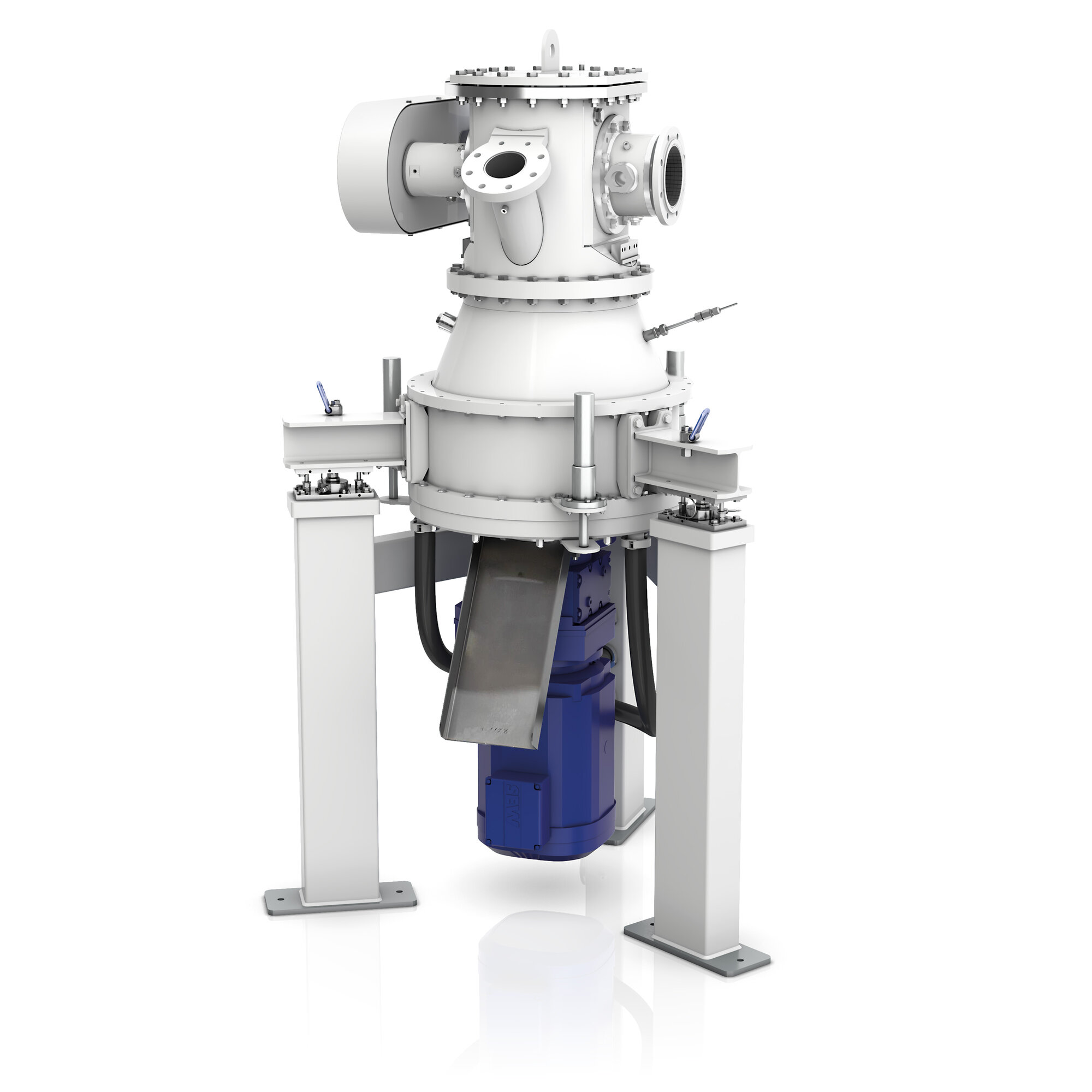
Customer Story: Aluminium oxide with the PULVIS
In a customer trial with aluminium oxide, there were four key features that finally tipped the scales in favor of installing a plant with the PULVIS agitated mediamill:
simplified dry grinding process without jet mills or wet mills
steeper particle size distribution than with conventional wet mills with hydrocyclones due to state-of-the-art classifiers
lower investment costs
lower operating costs due to energy savings
Value 数值 | Values achieved with the PULVIS 600 |
D50 | 0,9 µm |
D97 | 3,9 µm |
Capacity | 49 kg/h |
Downloads


Contact Us
Feel free to contact us for any inquiries.