






Glass Powder
Glass powder is an amorphous silicate hard powder produced via high-temperature melting, quenching and ultra-fine grinding. It is divided into three core grades by particle size: conventional industrial grade (D50=2~10μm), ultra-fine grade (D50=0.5~2μm), and nano grade (D50=50~500nm). Particle size is the core indicator defining its application scenarios.
It is a pure white amorphous powder with regular particle morphology and excellent dispersibility. It has a Mohs hardness of 6.5~7.5 for superior scratch and wear resistance, a refractive index of 1.48~1.54 highly matching most matrix resins for excellent transparency, and a softening point ranging from 300℃ to over 800℃ with adjustable thermal expansion coefficient for multi-substrate sealing. It also features outstanding electrical insulation, weather resistance and anti-aging performance.
Its main component is SiO₂, which can be compounded with B₂O₃, Al₂O₃, ZnO and other components on demand, with lead-free and environment-friendly systems as the mainstream. It has extremely strong chemical inertness at room temperature, with excellent acid and alkali resistance and storage stability. When reaching the softening temperature, it forms a dense glass phase and realizes chemical bonding with substrates, and can be adapted to different resin systems through surface modification.
Process
The mainstream processes currently used in the industry are plagued by three unavoidable core pain points:
Inadequate ultra-fine preparation capacity, with difficulty breaking through the upper limit of achievable fineness
Low comminution energy efficiency, resulting in unsatisfactory output under the same energy input
Cumbersome production line layout with low equipment integration
To address the core industry pain points in high-end glass powder production, we present the AFG Fluidized Bed Opposed Jet Mill, equipped with Hosokawa Micron’s patented high-precision turbine classification system. Specifically engineered for the efficient, high-precision, large-scale manufacturing of high-end glass powder, it is the ideal solution to meet the full range of production scenario requirements for high-end glass powder. With three core advantages – breakthrough in the ultra-fine particle size limit, significantly increased output at the same energy consumption, and integrated compact structural design – the equipment comprehensively solves the inherent defects of traditional processes, as detailed below:
Precisely Controllable Ultra-Fine Particle Size, Breaking Through the Industry Fineness Limit, Perfectly Adapted to High-End Application Requirements
Equipped with Hosokawa Micron high-precision turbine classifier, the equipment enables precise control of the median particle size D50 of the finished glass powder through stepless frequency conversion adjustment of the classifier wheel speed, fully covering the full particle size range requirements from submicron scale to tens of microns. It can not only achieve efficient mass production of conventional industrial-grade glass powder (D50=2–10μm), but also stably manufacture submicron ultra-fine electronic-grade glass powder (D50=0.5–2μm), completely breaking through the ultra-fine production bottleneck of traditional processes.
Significantly Increased Output at the Same Energy Consumption, Maximizing Cost Reduction and Efficiency, Balancing Ultra-Fine Production and Large-Scale Manufacturing
Through flow field optimization and process innovation, the AFG Fluidized Bed Opposed Jet Mill achieves maximized utilization of comminution energy. Compared with conventional jet mills, it delivers a significant increase in finished product output under the same energy input, with an even more prominent energy efficiency advantage especially in the production range of submicron ultra-fine powders.
Integrated Compact Structural Design, Minimalist Production Line Layout, Efficient Full-Process Control
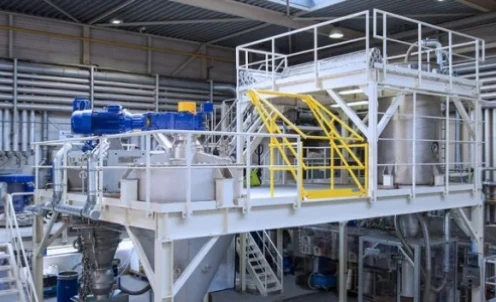
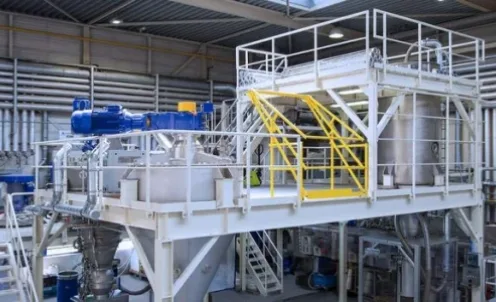
The AFG adopts a highly integrated, one-piece compact structural design, which highly integrates the fluidized bed grinding chamber, the patented high-precision turbine classification system, and the core units for finished product classification and collection. Compared with the cumbersome production lines of traditional processes that require separate equipment for grinding, depolymerization, classification, screening and other processes, the equipment features a simplified structure and significantly reduced footprint, realizing a more compact production line layout and greatly cutting down enterprises’ upfront equipment investment and plant construction costs.

Contact Us
Feel free to contact us for any inquiries.