







Barium Titanate
Barium titanate (chemical formula: BaTiO₃) is a typical perovskite ferroelectric ceramic material, known as "the pillar of the electronic ceramic industry". It is a core basic powder material for passive electronic components, new energy and other fields. Particle size is the core indicator defining its application scope. Mainstream products are divided into three grades: conventional micron grade (D50=1~5μm, for high-voltage capacitors and PTC thermistors), submicron grade (D50=0.2~1μm, the industry mainstream for general Multilayer Ceramic Capacitors, MLCC), and nano grade (D50=50~200nm, with excellent monodispersity, the core substrate for automotive-grade/high-end MLCC).
It has a tetragonal ferroelectric phase at room temperature, with a Curie temperature of approximately 120℃. Its core advantage is the ultra-high dielectric constant (1000~6000), coupled with outstanding ferroelectric, piezoelectric and Positive Temperature Coefficient (PTC) effects. The sintered ceramic body has excellent mechanical strength and thermal stability, and the powder features good fluidity and forming adaptability.
Process
Whether barium titanate is synthesized via the hydrothermal method or prepared through solid-state sintering, it is highly susceptible to the formation of soft agglomerates, or even mild hard agglomerates, during its synthesis, drying and material transfer processes.
These agglomerates will not only result in out-of-specification equivalent particle size and broadened particle size distribution of the powder, but also cause inhomogeneous densification and abnormal grain growth during the downstream sintering process, ultimately resulting in fatal defects in the dielectric film layers of Multi-Layer Ceramic Capacitors (MLCC), including pinholes, insufficient voltage withstand performance, and breakdown failure.
Therefore, the core criterion of the barium titanate depolymerization process is to eliminate the impact of agglomeration to the maximum extent while fully preserving the particle size, morphology and crystallization properties of the primary crystal grains.
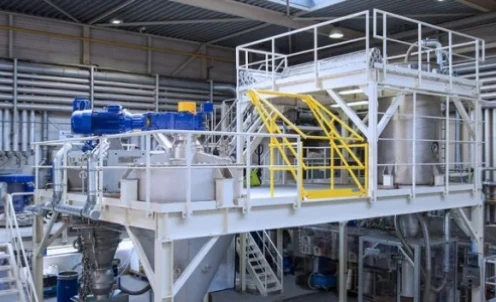
To address the challenges in the depolymerization of barium titanate powder, our company’s air classifying mill is custom-developed for the requirements of gentle depolymerization and precise classification of barium titanate powder. It covers full-scenario depolymerization demands for barium titanate ranging from conventional micron-scale to nano-scale, making it the core preferred equipment for the depolymerization and production of high-end electronic-grade barium titanate powder.
The equipment boasts three core advantages: more sufficient depolymerization, finer controllable particle size, and perfect restoration of primary particle size, as detailed below:
More Sufficient Depolymerization, Fully Resolving the Industry Pain Points of Barium Titanate Agglomeration and Dispersion
Finer Controllable Particle Size, Precise Production Capacity Covering the Full Particle Size Range
Perfect Restoration of Primary Particle Size, Complete Retention of Core Properties of Primary Crystal Grains

Contact Us
Feel free to contact us for any inquiries.