








Talc
Talc has been used for so many different application for a very long time. In daily life, like cosmetics, body care, food, medicine and many more.
The industry is demanding increasingly high demands on the already high quality mineral through its special properties. Due to its lamellar structure, high opacity and high degree of whiteness, talcum is an ideal filler for paints, ceramics and plastics.
In particular, high quality standards are required for the plastics industry for the automotive sector and for the compounding world in general.
For talc, this means high levels of fineness and high delamination, which in turn means high strength.
In order to optimally transport the micronized mineral and to promote it in premixes for masterbatches, compacting the fine powder is almost essential.
High energy efficiency
High laminarity
High finenesses d50 < 0.5 µm
High degree of whiteness
Process
Dry jet milling
For standard applications, jet mills for fineness of 2-5 μm (mean particle diameter) are used worldwide.
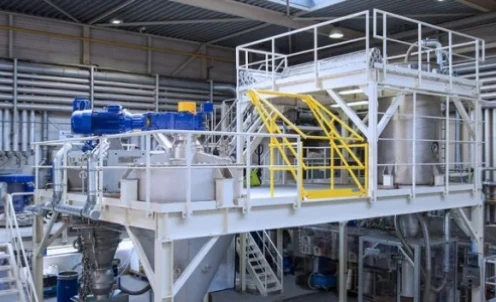
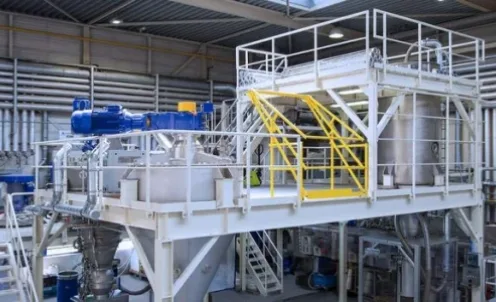
Our TDG fluidized bed Jet mill with integrated TTD classifier wheel what is supported in bearings on both sides has the advantage of achieving finenesses down to 0,5 µm and at the same time preserving the laminar particle structure.
High-pressure operation with high temperatures results in the best possible throughput and thus optimum energy consumption. Depending on the origin and properties of the pre-ground raw material, it is possible, for example, to produce finenesses of 0.7 μm on the 500/800 TDG at a throughput of up to 0.5 t / h.
In addition of water or silane by spraying into the grinding container is required already a normal mode of operation.
Dry agglomeration
A whole range of problems can arise when processing fine particles. Due to their low bulk density, these particles have poor flowing properties, and separation during handling is also difficult. In addition, there is a risk of dust explosion. One way to prevent these problems is to compact them. This results in the following advantages:
Continuous process
Low energy consumption
lower moisture load of hydrolysis-sensitive particles
Compacting process
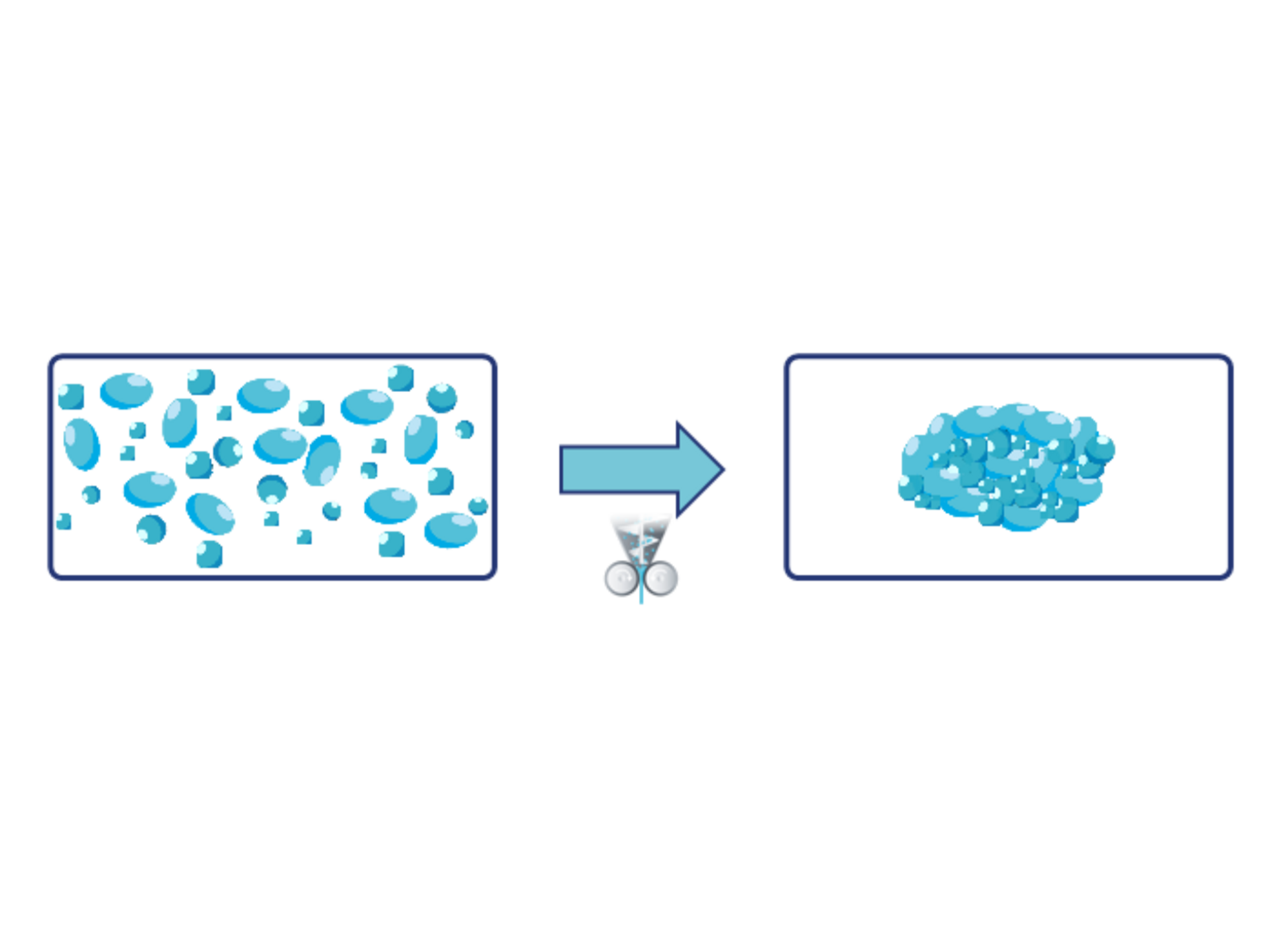
Agglomeration of powder particles by use of pressure:
Compaction of a powder by two rollers rotating in the opposite direction.
Agglomeration occurs through the formation of interparticle bonds under mechanical pressure.
Compaction of Talc
The compaction of talc on roller presses can meet the described demands. Due to the relative low bulk weight of fine talc, the roller presses must be equipped with a vacuum de-aeration for this purpose. Depending on the feeding material and its grain size, different throughput capacities can be achieved with a roll press of the ARC MS or CS series.
The Kompaktor is designed for the de-aeration of talc (densification). A high bulk density without creation of hard spots will be achieved during the densification process. The powder will be fed into a large silo above a horizontal screw. An agitator or vibration nozzles above the screw prevent any bridging of the talc powder. The horizontal screw has a vacuum de-aeration system for increasing the efficiency of the screw and increasing the throughput of the Kompactor. The talc will be compacted to flakes in the roller gap of the Kompaktor. After compaction the material is normally packed into silos or normal bags.
Advantages of compacting technology
Increase of bulk density
Reducing transport costs
Better control of feed
Preparation for following processes (e.g. extruder)
Improvement for dosing processes
Improvement in extrusion process through a better homogenization

Contact Us
Feel free to contact us for any inquiries.