






Wollastonite
Wollastonite is a naturally occurring calcium metasilicate mineral. With its unique acicular/fibrous crystal structure, high whiteness, low oil absorption value, and excellent chemical and thermal stability, it serves as an indispensable functional reinforcing filler in plastics, rubber, coatings, ceramics, building materials and other sectors. When applied as a filler, its acicular structure can significantly improve the tensile strength, flexural strength, impact toughness and dimensional stability of composite materials while cutting production costs.
The core quality metrics for wollastonite fillers are ultrafine particle size, aspect ratio retention and surface modification performance. For high-end applications, products are required to have a median diameter (d50) of 2 microns and retain the original acicular structure to the greatest extent. Surface modification with silane coupling agents can greatly enhance its compatibility with organic matrices and give full play to its reinforcing and toughening effects.
Hosokawa Solution
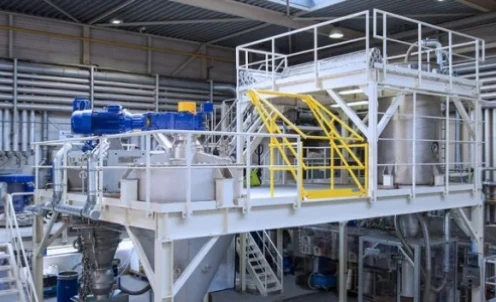
In response to the processing characteristics of wollastonite and market pain points, we provide an integrated solution combining the AFG fluidized bed opposed jet mill with in-line silane coupling agent surface modification. It realizes ultrafine grinding, structure retention and efficient surface modification simultaneously, perfectly matching the production requirements of high-end wollastonite fillers.
Core Advantages of the Solution
Stable ultrafine particle size with narrow distribution:The AFG jet mill adopts supersonic airflow collision grinding technology, which can stably produce ultrafine wollastonite powder with d50 = 2 μm. It strictly controls coarse particle content and ensures that product particle size indicators meet high-end industry requirements.
Maximum retention of acicular structure:
The unique inter-particle collision grinding mode avoids hard impact between grinding media and the equipment inner wall. It maximally preserves the original acicular fiber structure of wollastonite, maintains the product aspect ratio, and gives full play to its core value of reinforcement and toughening.
Integrated grinding and modification with excellent coating effect:Silane coupling agent is sprayed synchronously during the grinding process. Leveraging the heat and surface activity generated by high-speed powder collision, uniform and firm coating of the coupling agent is achieved, significantly improving the compatibility of the product with organic matrices such as plastics and rubber.
Compact, energy-saving system with low operating cost:
The entire system adopts a modular integrated design. Compared with the traditional separate "grinding + modification" process, its floor space is reduced. The jet mill has high energy utilization, and unit product energy consumption is lower than that of conventional equipment, greatly reducing production and operating costs.
Process
The high-end wollastonite filler market has imposed increasingly stringent requirements on product fineness and structural integrity. Conventional processing equipment generally suffers from the following core pain points:
Inability to stably achieve ultrafine particle size, resulting in coarse products:
Conventional equipment has low grinding efficiency and cannot consistently meet the ultrafine requirement of d50 = 2 μm. Products contain a high proportion of coarse particles and have a wide particle size distribution, failing to satisfy the application standards of high-end plastics and coatings industries.
Severe damage to acicular structure during grinding:Traditional grinding equipment operates on impact and rolling principles, which break a large number of wollastonite acicular fibers. This leads to a sharp decline in product aspect ratio, completely depriving the material of its core reinforcing and toughening functions. The product can only be used as a common filler with low added value.
Separated surface modification and grinding with poor performance:The traditional process adopts a step-by-step mode of "grinding first, modification later". Silane coupling agents are difficult to coat uniformly on the powder surface, with low coating rate and easy peeling. This results in poor dispersibility of the product in organic matrices and greatly compromised downstream application effects.
High energy consumption, large floor space and unstable quality:

Contact Us
Feel free to contact us for any inquiries.