





Polymes
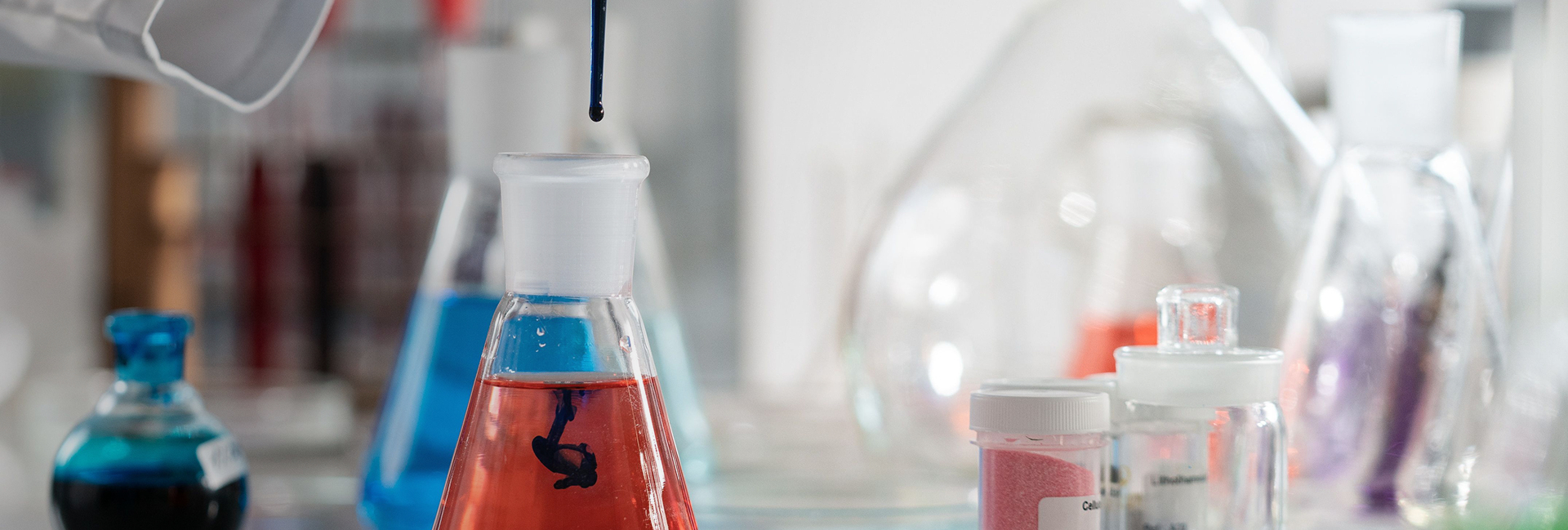
Polyethylene Terephthalate (PET) is one of the major polyester resins available in the market. It has superb functional and handling performance for the price and is a material used in many applications. Major applications are for use in PET bottles and industrial textiles, and recently its use in weather-resistant films and optical films is increasing. Polyester is synthesized through a condensation polymerization process, which limits the strength of the polymer, limiting its use to textile applications. Solid State Polymerization is a technology that increases the strength of the polymer, thereby widening the applications for polyester.
Below are some uses for Solid State Polymerized PET
Bottles
Industrial Textiles
Tirecord
Weather-Resistant Film (for Solar Panels)
General Textiles
Food Packaging
Optical Film
Below are some applications of other Solid State Polymerized polymers
Industrial Textiles
Tirecord
Circuit Boards
Battery Casing (heat-resistant, non-conductive)
[Super Engineering Plastics (special PA etc.)]
High-strength textiles (bulletproof vests, airbags)]
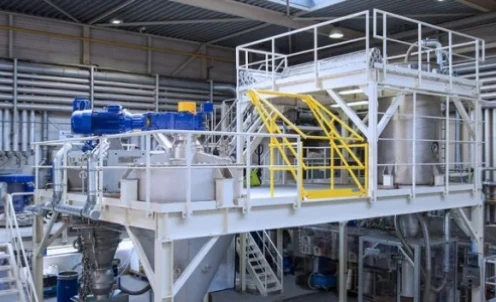
![Drying System [End use example: Optical Film (PET)]](/static/upload/images/20260907/04908e00bf48113ec5487952ebe92a5f.jpg)
Drying System [End use example: Optical Film (PET)]
In optical films used for LCD displays and precision photography, transparency, surface imperfections, and uniformity of film thickness directly affect the quality of the final product. PET used for these applications must be dried to ultra-low moisture content in the range of 10 to 100ppm in pellet form to prevent breaks in the film-forming process. Additionally, crystallinity must also be uniform. Hosokawa’s Drying System (DRS) is an optimal drying system that solves all of these problems.
The drying system consists of crystallization and drying steps.
Crystallization Step
Main Purpose: Crystallization, Heating to Drying Temperature
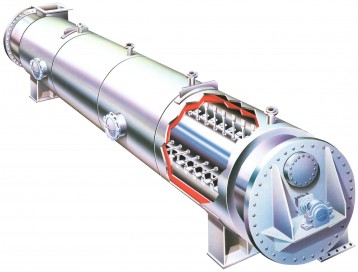
Equipment Used: Solidaire
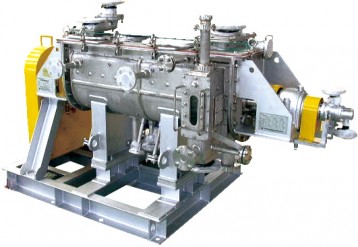
A high-rotation-speed agitator rotating within a casing with a heated jacket enables quick and efficient heat transfer while crystallization occurs very uniformly. This is a very important factor for achieving uniform film thickness.
Drying Step
Main Purpose: Drying
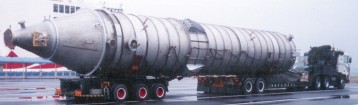
Equipment Used: Hopper Dryer
The uniformly crystallized polymer is dried in the hopper dryer using a low-dew-point gas. The crystallized polymer is already at the drying temperature, so there is no need for further heating in this step. Because no extra heating is required, the use of low-dew-point gas can be kept to a minimum, leading to lower running costs.
Solid State Polymerization System [End use example: Tirecord (PET)]
Tirecord is a high-strength textile that is woven into automobile tires. Metal fibers weren used in this application in the past, but due to their lightweight and durability, PET and PA are increasingly being used recently.
Since high strength is required for this application, a Solid State Polymerization step is required for PET to increase its strength. In this process, the molecules polymerize with each other, increasing the strength of the polymer while reaction byproducts are simultaneously removed from the polymer.
Solid State Polymerization (SSP) consists of 5 steps: crystallization, drying, heating (secondary crystallization), polymerization, and cooling. The crystallization and drying steps are the same as those shown in the previous section “Drying System”.
Heating (2nd stage Crystallization) Step
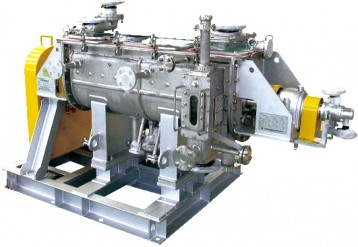
Main Purpose: Heating to reaction temperature, additional crystallization
Equipment Used: TorusDisc
The following polymerization process uses a static bed (Hopper Reactor). The polymerization is conducted at a temperature close to the melting point of the polymer, so precise temperature control is required. When heating PET, crystallization occurs, which causes heat to be generated. If crystallization is insufficient, additional heating of the polymer may occur during the polymerization process. Since the polymerization is conducted near the melting point, such heating can result in melting. To prevent this from occurring, the degree of crystallization is further increased during the heating step, preparing the material for a more stable polymerization step.
Polymerization Step
Main Purpose: Solid State Polymerization, Removal of byproducts
Equipment Used: Hopper Reactor
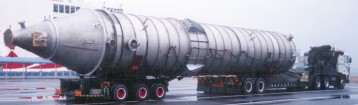
In order to reach the required strength (polymerization), the polymer is held within a hopper reactor while the polymerization reaction occurs. The level of polymerization is dependent upon the residence time in the Hopper Reactor, so the design has been optimized to minimize the residence time deviation of the polymer pellets. The Hopper Reactor is designed with a full jacket to limit the horizontal temperature distribution, and to distribute the carrier gas evenly.
Cooling Step
Main Purpose: Cooling, Stopping the Solid State Polymerization Reaction
Equipment Used: TorusDisc
After the required level of polymerization is achieved, the polymer is quickly cooled to stop the polymerization reaction and to maintain the product quality. Cooling is also necessary to improve the handling qualities of the polymer in the downstream process.

Contact Us
Feel free to contact us for any inquiries.