





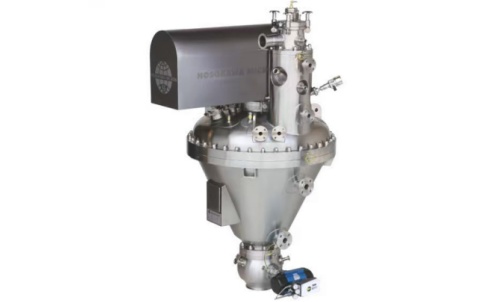
Drying
Adopting energy-efficient drying technology, it enables continuous and automated production, ensuring excellent batch-to-batch consistency. It efficiently handles a wide variety of complex materials, including high-moisture, highly sticky, and heat-sensitive types, while providing precise control over powder moisture content and morphology.
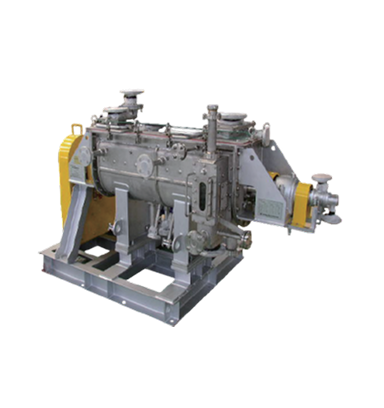
TorusDisc TD
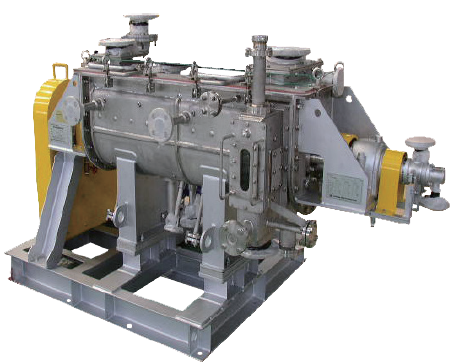
The TorusDisc is a indirect dryer consisting of a jacket and torus-shaped discs.
Principle of Operation
The TorusDisc consists of a stationary horizontal vessel, equipped with a heating/cooling jacket, housing a tubular rotor with vertically mounted double-walled discs. As heating media (cooling media), hot water, steam, or thermal oil (industrial water, cooling water, or cooling media for cooling) acan be introduced to the jacket and rotor. The construction of the disc rotor for steam media is different from that of thermal oil. In case of steam media, the condensate is picked up by dipper pipes during the rotation of the discs and discharged continuously. In case of thermal oil heating, it enters one end of the rotor shaft, passes through each disc and goes out from the other end of the shaft. In either construction (steam/oil), the dryer is constructed in such a way each disc is evenly heated with uniform temperature distribution.
Feed material is charged at one end of the dryer, and then it is transported through the annular space between the discs and the vessel toward the discharge port. Conveying vanes are fixed to the outer rim of the discs to control conveyance. Stationary agitator plows are located between the discs to the better mix the powder, to convey the material to the next annular space, and to prevent material build-up on heat transfer surfaces. Thus, the material securely travels between the discs receiving heat, and short-circuiting above the discs is prevented. The functions of the vanes and the plows increase the heat transfer efficiency by agitating/mixing. The dried product is discharged by overflow from the weir placed at the end of the vessel. Adjusting the height of the outlet weir controls the residence time. By applying inert gas, such as N2, as a carrier gas, it is possible to dry volatile solvents, to prevent oxidation of the material or moisture absorption by the product.
Features
Compact structure with large heat transfer area. Reduced heat loss to the outside, and effective use of heat energy.
High heat transfer coefficient. For dry powder, the heat transfer coefficient is 20-35kJ/m2 h K, for wet powder; 30-60kJ/ m2 h K, for slurry, 60-230kJ/m2 h K.
Wide operating applications for drying, heating, cooling, vacuum drying and combined operation with hot air.
Adjustable material hold-up. By adjustment of the conveying vanes and the height of the overflow weir, the material hold-up quantity can be controlled.
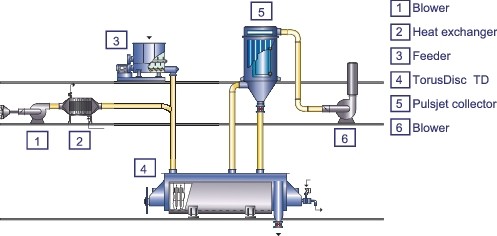
A very limited quantity of carrier gas is required. Ancillary equipment such as a gas heater and a blower are relatively small. This leads to a space and energy saving system.
It is possible to raise the material temperature up to 200°C. Applicable for drying and reaction of heat-resistance resin.
Specifications
| Model | Heat transfer area (m²) | Volume (m³) | Dimensions (mm) — Length | Dimensions (mm) — Width | Dimensions (mm) — Height | Rotor speed (rpm) | Motor (kW) |
|---|---|---|---|---|---|---|---|
| TD-12-3 | 2 | 0.055 | 1600 | 400 | 600 | 10~50 | 2.2 |
| TD-16-4 | 3.2 | 0.11 | 2000 | 500 | 750 | 8~35 | 3.7 |
| TD-20-5 | 5.7 | 0.21 | 2400 | 600 | 900 | 7~30 | 5.5 |
| TD-26-5 | 9.4 | 0.44 | 2450 | 800 | 1100 | 5~25 | 7.5 |
| TD-26-7 | 13.2 | 0.61 | 3100 | 800 | 1100 | 5~25 | 11 |
| TD-36-6 | 17 | 1.03 | 2900 | 1100 | 1250 | 3~16 | 15 |
| TD-36-9 | 25.6 | 1.55 | 3800 | 1100 | 1250 | 3~16 | 22 |
| TD-36-12 | 34.1 | 2.07 | 4100 | 1400 | 1250 | 3~16 | 30 |
| TD-48-9 | 38.6 | 2.44 | 4200 | 1400 | 2100 | 2~12 | 30 |
| TD-48-12 | 51.4 | 3.26 | 5100 | 1400 | 2100 | 2~12 | 37 |
| TD-48-15 | 64.3 | 4.07 | 6100 | 1700 | 2100 | 2~12 | 45 |
| TD-60-12 | 73.1 | 4.87 | 5650 | 1700 | 2650 | 2~10 | 45 |
| TD-60-18 | 109.7 | 7.3 | 7450 | 1700 | 2650 | 2~10 | 75 |
| TD-72-18 | 146.1 | 10 | 7600 | 2050 | 3050 | 2~8 | 75 |
| TD-84-20 | 211.4 | 14.8 | 8600 | 2300 | 3500 | 1.5~7 | 90 |
| TD-96-24 | 321.8 | 23 | 10000 | 2650 | 4000 | 1.5~6 | 110 |
| TD-96-32 | 459.1 | 30.7 | 12500 | 2650 | 4000 | 1.5~6 | 150 |
experimental verification
Before investing in new equipment, please conduct tests on the materials to be used at the Hosokawa Testing and Process Development Center based on actual production conditions. Our experienced experts will assist you in determining the most effective mixing, granulation, or drying processes, helping you transition from laboratory testing to a comprehensive production testing phase. Whether you need to test the performance of a single machine or evaluate the entire production line, we can provide tailored testing services and process optimization solutions to ensure reliable system operation and excellent performance.
More
Contact Us
Feel free to contact us for any inquiries.